
Love Required Tolerating Chaos
What growing up in chaos taught me — and how healing finally set free.

Before.
Do you remember Shrinky Dinks?
Those thin sheets of plastic we would color on as children and then slide into the oven to watch them curl, twist, and collapse into a tiny, hardened version of what they used to be. Looking back, it is almost comical. Who thought melting plastic in an oven was safe for children?
I remember standing there, watching my creation shrink into itself, edges folding, colors deepening, the whole piece tightening into something small and stiff. Once it cooled, it became a necklace, a keychain, or some other little ornament that eventually ended up lost in a drawer or thrown away.
That is how I felt growing up.
I learned early that shrinking kept the peace.
I learned that being small, quiet, and agreeable was safer than taking up space.
I became like those little plastic ornaments, pretty and polite, placed wherever someone else wanted me. Ornaments do not talk. Ornaments do not feel. Ornaments certainly do not have opinions.
As a child, love required tolerating chaos, which meant becoming silent enough not to make the chaos worse.
And sometimes I wonder now:
Was it the toxic chemicals of the Shrinky Dinks melting in the oven,
or the toxicity inside my home,
that taught my body to live in a constant state of fight-or-flight?
Both seemed to make me curl inward.
Both shaped a nervous system that learned to brace instead of breathe.
Both taught me that safety came from becoming smaller.
That kind of chronic bracing followed me for years.
Childhood teaches you what and who to trust in life. My home was disruptive, dysfunctional, and dismissive. I learned to dismiss my intuition, to override the pain I felt, to silence my emotions, and to ignore the warnings my body whispered. That training taught me to suffer in silence, whether the pain was physical or emotional. And the cost of that silence showed up years later in profound ways, because I had never learned how to ask for help. I also learned to accept the chaos as if it were normal, to adapt to it instead of challenge it.
I grew up in a world where trust did not exist. Without that foundation, everything was fractured and doomed to crack under pressure later in life. In place of trust, I tried to prove my worth, my value, my truth. If I was in pain, something had to be visible, such as blood, welts, or swelling, or it did not exist. Abuse is a silent killer. It leaves marks where no one sees them, scars no one has access to, and wounds buried deep in the soul. So I functioned within the dysfunction, allowing myself to be seen even if I could not yet be heard. And somewhere inside, I held onto one quiet truth: one day, I will be heard.
The Breaking Point
The pattern lasted far too long. A few years ago, I walked away from a man I had known for twenty years, a man I trusted; the man I almost married. But my understanding of love and trust had been shaped by childhood, and this relationship became another repetition of my past. He was controlling, unpredictable, and quick to explode, and I became his target. And his behavior was not confined to his temper. It seeped into the way he treated my body, my health, and my truth.
The truth is this:
He dismissed my allergies; only when the hives appeared did he accept them as real.
He dismissed my migraines, convinced they were strategies to avoid him rather than a condition I endured.
He dismissed my autoimmune disorder and the many ways it manifested. When stress intensified my symptoms, he assumed I was trying to manage the moment rather than tend to my own health.
Even on a simple weekend getaway, as we stood watching a cluster of seals, one slipped a few feet away from the rest. He smirked, glanced at me, and murmured under his breath, “She must have a migraine. Just joking.”
“Just joking” is never that. It was a jab, another reminder that my pain was something he mocked rather than cared about. The moment the words left his mouth, my body absorbed them. Anxiety tightened my chest. Tension rose through my shoulders. A wave of nausea hit instantly, my body shouting what my voice could not yet say. My nervous system reacted faster than my mind could process, because it had been trained for years to brace for whatever might come next.
The tension inside me pulled everything inward. My body contracted. I became small again. I held my breath, and with it, I held my words.
He questioned everything about me, and still, I accepted him, because this was the truth I knew, the pattern I learned, and the life I had lived for all of my years. I accepted him because I had been raised in a world where dismissal felt normal. It was what my system understood, what my childhood had trained me to expect. His disbelief mirrored the very environment I grew up surviving. It felt familiar, and at that time, I did not yet realize how damaging something familiar could be.
But the day he covertly gave me an allergen, the day my body went into crisis and I was ambulanced out of our home, is the day everything changed. That day, I almost lost my life. That day, I woke up. And I said with a clarity I had never felt before: never again will anyone control me.
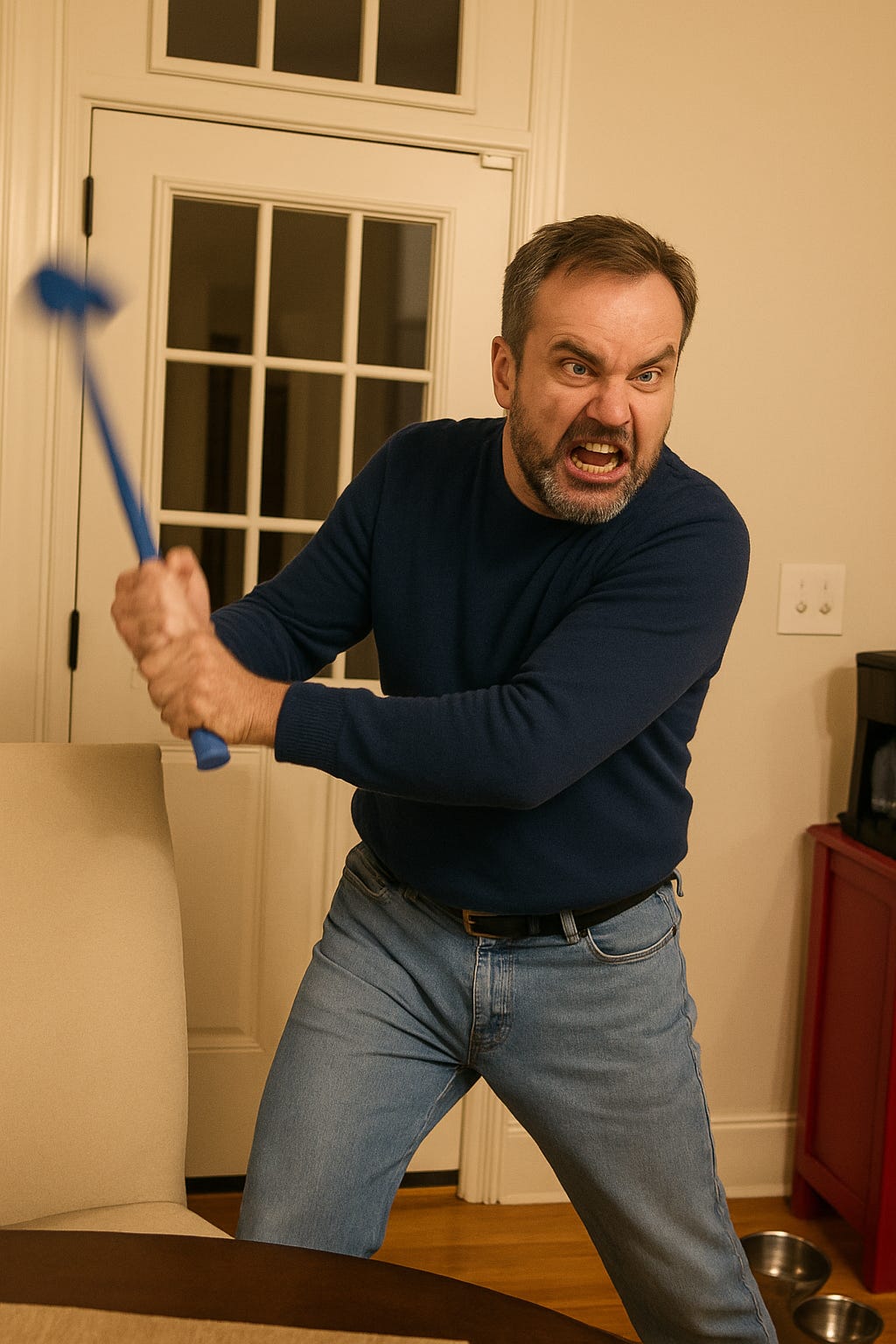
My nervous system was calibrated to hyper-reactive people. I did not know what calm or steady felt like. I understood threats, fear, and explosive temperaments. And like the moment in the picture above, the man I almost married threatened me in the same way. That was the kind of volatility I lived with, the kind of energy my body had been trained since childhood to absorb.
There was no middle ground with him. His world existed in extremes. It was either volatility or contempt, either an eruption or a stream of hateful rhetoric. There was never a place for steadiness, curiosity, or care.
I remember saying to him once, during an argument, “You think I am like a china doll you can place on a shelf at will.” It was the grown-up version of being a Shrinky Dink, pretty, silent, and easy to move around. He did not hesitate before answering, “I wish you were, because then you would not speak.” That was the truth of our relationship in one sentence. He wanted a decoration, not a partner. Silence, not a voice. Obedience, not truth. And still, for too long, I accepted that.
The pattern did not stop until I stopped it.
I have written about this turning point before, and called it Prescribed Burn. This is for anyone who wants a deeper understanding of what it meant for me to leave.

Breaking a lifelong pattern does not merely create change. It creates space.
Space to breathe, to choose differently, and to rebuild a life that finally aligns with who you are.
Becoming
Healing meant coming home to my townhouse, the space that had been staged for sale, stripped bare, empty and cold. It was unsettling at first, walking into a home that no longer felt lived in. But it was also the first place I could finally breathe. That emptiness became room for expansion. That coldness became clarity. It was there, in that quiet space, that I began to build a life anew on my own, and in my own way.
It was there that I began creating the safety I had always craved. I deliberately rewrote the definitions I once held. I redefined trust, redefined safety, redefined relationship, and, most importantly, redefined how I relate to myself. I learned to decide how I want to be seen in the world, not how others wanted to shape me.
I did not have a name for it then.
I did not understand how childhood chaos threads itself through adulthood, shaping the way we respond, the way we lead, and the way we love. It disguises itself as being flexible, being accommodating, being the strong one, being the person who absorbs impact.

Healing has a way of breaking old patterns open.
Now, I no longer shrink.
I no longer contort myself to fit someone else’s comfort.
I no longer fear coloring outside the lines or making myself too visible.
And I absolutely no longer tolerate chaos disguised as connection.
Now, I give myself permission
to breathe,
to cry,
to feel,
to speak,
to say “no,”
and to expand into the woman I was always meant to be.
Because I am no longer a Shrinky Dink.
Maybe I am like an Etch A Sketch now, a new design each day, lines that can be rewritten, patterns that can be changed, a self forever becoming.
Etch A Sketch was never about erasing.
It was about becoming, crafting, shifting, changing in the moment,
knowing you could redraw yourself without losing who you were.
I am no longer melting under pressure or collapsing into smaller versions of myself.
Today, I embrace the solitude of silence,
a moment of shared laughter,
the ache of what was,
the hope of what could be.
I let it all sit beside me without rushing any of it away.
I am the woman who knows her worth, honors her boundaries, and trusts the power of her own voice, and I refuse to melt down into a smaller, hardened version of myself ever again.
Reflection Question
Where in your own life did you learn to shrink and what part of you is ready to take up space again?
Christina Perri: A Thousand Years. A Song for You and Your Inner Child
This song is for you
and for the inner child who still lives inside you
the one who learned to shrink,
to stay quiet,
to survive what no child should have had to carry.
It’s a reminder that you have been worthy of love
for a thousand years,
and for every year still to come.
Your inner child deserves to hear this.
Deserves softness.
Deserves safety.
Deserves a love that doesn’t ask her to disappear.
So let these notes wrap around the parts of you
that still feel small or uncertain.
Let the melody hold you the way you should have been held.
And to your inner child, I say:
Speak up.
Stretch out.
Take up space.
Live in this world fully, fiercely, boldly…
with the adult you who finally knows how to keep you safe.
This song is a gift of strength and courage,
a reminder that healing is not only possible,
it is already happening inside you.
Author’s Note
If this story touched something inside you, I’d be honored to hear your reflections.
Whether you’ve lived through chaos, rebuilt your voice, or carried wounds no one else could see, your story matters. Sharing reminds us that we are not alone in the slow, powerful work of becoming.
If this piece resonated, I’d be grateful for a like, a comment, or a share.
And if you’d like to walk this healing journey with me, I invite you to subscribe.
With gratitude,
Chellie 🩷
RESOURCES
The National Domestic Violence Hotline (U.S.)
Text: START to 88788
Call: 1-800-799-SAFE (7233)
National Sexual Assault Hotline (RAINN)
Call: 1-800-656-HOPE (4673)
UCLA Meditations
Love is Respect (for young adults and relationship dynamics)
Text: LOVEIS to 22522
Chellie Grossman is a Certified Life Coach, Keynote Speaker, and Writer who empowers leaders to reclaim their voice, embrace their strength, and lead with authenticity and purpose.
I read the Friday Exhale .. TO Do or To Don't story, hit Leave a comment in the email.. it took me here.. so I'll leave my To Don't here .. To don't beat myself up for staying too busy or being afraid to add to any noise on substack, as if my voice doesn't matter. My story matters .. so I'll add it to my To Do list for the weekend and week ahead ... to do by Wed. Or To Don't!
Your writing transported me back into my early childhood. I recall standing at the Woolworths soda counter. There were balloons tied to the posts, and if you ordered a banana split, they would give you one to pop. Inside was the price you would pay. A nickel was full price, but the slips of paper ranged from 1 cent to 5 cents, and on occasion, there would be a free one. Sometimes we just walked by and wished for one, but on occasion we stopped and got one. That memory reminded me of the love I felt for my Mother, especially when I got one-on-one time with her. I closed my eyes and visualized walking through the store and even going downstairs into the "bargain basement." Thank you, Chellie .